

July 11, 2026: Torah Portion Parashot Mattot-Masei: "Tribes-Journeys of"

In this study, we will explore the Double Torah Portions Mattot: "Tribes", and Masei: "Journeys of"
Double Torah Portions: Numbers 30:1-32:42 & Numbers 33:1-36:13
Haftarah: Jeremiah 2:4-28, Jeremiah 3:4
Brit Chadashah (New Testament): Matthew 5:33-37, James 4:1-12
New Moon Feast: Rosh Chodesh Av - July 14th, 2026

This week's Parashah covers two Torah Portions: Mattot: "Tribes", and Masei: "Journeys of"
📖Mattot: "Tribes" – Numbers 30:1-32:42
🪶 Summary of Matot:
• Vows and Oaths: Moses instructs tribal leaders about the binding nature of vows, especially regarding women under authority.
• War with Midian: Israel defeats Midian and takes spoil, but Moses is angered that some Midianite women are spared.
• Division of the Spoil: Rules about dividing plunder among soldiers and the community.
• Reuben, Gad, and Half of Manasseh request land east of the Jordan.
Dedication: To the glory of ADONAI, Giver of the Torah and Spirit of Life to His people Israel - for the honor of Yeshua, our Messiah. This journey is for the faithful Bride who walks by the Spirit and obeys His leading in the wilderness of preparation.
Opening Blessing: Blessed are You, O LORD our God, King of the Universe, who has given us the Torah of truth and planted eternal life within us through Yeshua the Messiah.
This week's parashah (often combined with Parashah Masei) begins with the LORD giving instructions regarding the making of vows (nedarim). Any pledge made by a man in the name of the LORD must be fulfilled. A woman's vow, however, can be overturned and annulled by her father or husband on the day he learns of it (otherwise, the vow is considered fully obligatory, just as a man's vow).
Laws about Vows (nedarim)...
The words we use are important and represent our characters. Lying and deception are indicative of unbelief. Making a promise to do something -- making a vow -- is a serious matter, as the Messiah Yeshua taught us. Whenever we give our word, we are expected to keep it...
"33 “Again, you have heard that it was said to the people long ago, ‘Do not break your oath, but fulfill to the Lord the vows you have made.’ 34 But I tell you, do not swear an oath at all: either by heaven, for it is God’s throne; 35 or by the earth, for it is his footstool; or by Jerusalem, for it is the city of the Great King. 36 And do not swear by your head, for you cannot make even one hair white or black. 37 All you need to say is simply ‘Yes’ or ‘No’; anything beyond this comes from the evil one."
Matthew 5:33-37
"36 But I tell you that everyone will have to give account on the day of judgment for every empty word they have spoken. 37 For by your words you will be acquitted, and by your words you will be condemned.” Matthew 12:36-37
The Torah states plainly:
"If a man vows a vow to the LORD, or swears an oath to bind himself by a pledge, he shall not break his word. He shall do according to all that proceeds out of his mouth" Numbers 30:2
On the other hand, if a father overhears a child make a promise he does not agree with, he can say, "I nullify your promise." The husband of a wife who makes a vow is likewise subject to her husband's approval (or lack thereof).
In both cases, however, the nullification is valid only until sunset on the day he hears it. If he waits until after sunset, the promise must be kept - just as with a promise made by a man.
Some vows in the Scriptures are not condemned. For example, Jacob's vow (at Bethel) to give the LORD a tenth of everything he owned if he returned safely to Canaan is not considered foolish. Nor is the Nazirite vow regarded as bad in and of itself. And of course God's vows are precious to those who trust in Him. We must be careful, however, to remember that God will call each person into account for the words he or she has spoken.
The Voice Behind the Vow The Ruach and the Covenant of Words:
Let us begin with what leaves your mouth. Words are not just sounds they are spiritual contracts. The Torah opens this portion by teaching us the weight of a vow.
But what does it mean in the Spirit?
"Whenever a man makes a vow to ADONAI... he must not violate His word."
Numbers 30:2 (TLV)
This is not just about oaths. It is about whether your voice agrees with Heaven or not. The Ruach listens when you speak. And when you vow something in His presence, He watches for fulfillment.
Vengeance on Midian...
The LORD then commanded Moses to wage war against the Midianites for their role in plotting the moral destruction of Israel (through the evil counsel of Balaam of Beor). Led by Pinchas (a type of Mashiach Yeshua), 12,000 Israelite warriors (1,000 from each tribe) attacked and killed every male Midianite - including the archenemy Balaam and the five kings of Midian.
When the victorious Israelites returned to the camp, they took Midianite women, children, cattle and other possessions as spoils of war. Moses was not happy about this and reprimanded the soldiers for keeping the women alive (since they were the cause of the plague on the Jews in the first place).
He therefore ordered that all the Midianite women and boys to be executed (though the 16,000 virgin girls were made slaves).
The warriors, unclean by contact with the dead, were then required to stay outside the camp of the Levites and the Mishkan (temple) for seven days to undergo ritual purification. All of their garments and the spoils of war were cleansed according to Eleazar the High Priest's instructions.
The spoils of war were then divided equally between the warriors on the one hand, and entire congregation on the other hand. The soldiers - grateful for their miraculous victory (not a single Jew was killed) - contributed 1/50th of their spoils to the Levites and made an additional freewill offering at the Mishkan.
HAFTARAH:
In the Haftarah, Jeremiah describes punishments that will befall the people if they do not return to the LORD, but also promises redemption if they do. The choice is theirs. Since the Temple was destroyed and Judah was ultimately taken into captivity, it is interesting to read a key verse from the Haftarah:
"Before I formed you in the womb I knew you, and before you were born I consecrated you; I appointed you a prophet to the nations" Jeremiah 1:5
How are we to understand our responsibility in light of the overarching sovereignty of the LORD?
Ultimately, we are responsible for the choices we make - whether to return to the LORD or to continue to idolize our selfishness - but the LORD has the last word in the destination of our lives.
"The heart of man plans his way, but the LORD establishes his steps" Proverbs 16:9
How you reconcile this paradox will reveal a good deal about your own personal relationship with the LORD
Teaching:
🔹1. The Prophet Is Not a Busybody:
“But let none of you suffer as a murderer, a thief, an evildoer, or as a busybody in other people’s matters.” 1 Peter 4:15 (NKJV)
• A true prophet is not a meddler in people’s private affairs.
• Their words come not from curiosity or judgment, but from the burden of the LORD.
“Let the prophet who has a dream tell the dream, but let him who has my word speak my word faithfully. What has straw in common with wheat? declares the LORD.” Jeremiah 23:28 (ESV)
• Not every word is from God. The prophet discerns between flesh and spirit.
• He or she must not speak idle words, but faithfully release what God says.
🔹2. The Prophet Is the Voice of the LORD
“For the Lord GOD does nothing without revealing his secret to his servants the prophets.” Amos 3:7 (ESV)
“Then the LORD put out his hand and touched my mouth. And the LORD said to me, ‘Behold, I have put my words in your mouth.’ Jeremiah 1:9 (ESV)
🔹 3. Without Prophecy, the People Perish
“Where there is no vision, the people perish: but he that keepeth the law, happy is he.” Proverbs 29:18 (KJV)
“My people are destroyed for lack of knowledge. Because you have rejected knowledge, I also will reject you…” Hosea 4:6 (NKJV)
• The word “vision” (Hebrew: chazon, H2377) refers to prophetic revelation.
• Without prophetic guidance, people go astray, fall into sin, and perish.
🔹 4. Prophecy Restores — It Is For Edification, Exhortation, and Comfort
“But he who prophesies speaks edification and exhortation and comfort to men.” 1 Corinthians 14:3 (NKJV)
• True prophecy is not destructive — it’s restorative.
• It aims to rebuild, warn, and reconcile people to the Father.
“Your ancient ruins shall be rebuilt; you shall raise up the foundations of many generations; you shall be called the Repairer of the Breach, the Restorer of Streets to Dwell In.” Isaiah 58:12 (ESV)
• The prophetic mantle is to rebuild what was broken — including people’s hearts, lives, and purpose.
• A prophet doesn’t speak opinions — they carry the very breath of God.
• Their role is not performance, but obedient utterance.
🔹 6. Use the Word — Even Yeshua Quoted the Word to Satan
“It is written…”
“It is written again…”
“Away with you, Satan! For it is written…” Matthew 4:4,7,10 (NKJV)
• Even Yeshua, when tempted and provoked by Satan, did not argue emotionally — He simply stood on the written Word.
• Sometimes, when someone refuses truth, the only right response is to declare the Word and walk away in peace.
APPLICATION:
- Speak what the Spirit births.
- Be slow to vow but quick to obey.
- Let your Yes carry weight before God.
____________
📖Masei: "Journeys of" – Numbers 33:1-36:13
🪶 Summary of Masei:
• 42 Journeys: Review of the Israelites’ journeys from Egypt to the Promised Land.
• Boundaries of Canaan: God defines Israel’s future borders.
• Cities of Refuge: Six cities for accidental killers.
• Inheritance Protection: Tribal land must remain within tribes.
Wilderness Seasons, Hidden in the Journeys:
In Hebrew, 'Midbar' (מִדְבָּר): desert/wilderness, shares a root with 'Davar': word. Wilderness is where God speaks.
These seasons shape identity, remove idols, and build intimacy with Adonai. Delays are not denials — the wilderness is preparation for inheritance.
Torah Portion Mattot ended with the Israelites camped east of the Jordan River, near the plains of Moab, ready to finally enter the Promised Land. In anticipation of their return to the land, this week's portion begins with Moses recounting 42 sites the Israelites stayed during their 40 years of wandering in the desert - from their first camp after the Exodus (called Sukkot) to their current encampment across the river from the land of Canaan.
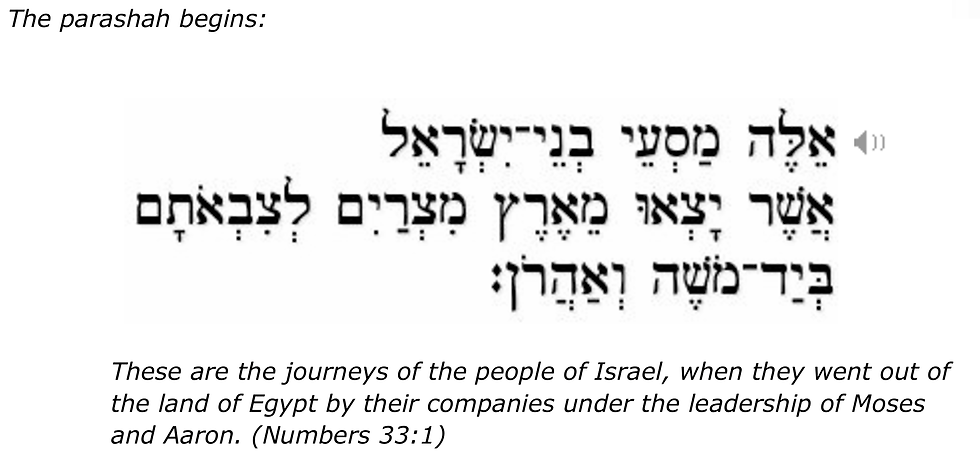
Recounting the Journey...
From the time they left Ramses in Egypt until they reached the plains of Moab (at the border of the Promised Land), Israel camped at 42 named locations. Before the Sin of the Spies (at Kadesh), Israel had camped at 14 locations en route to the land, but was then forced to wander for 38 more years until the original generation that sinned had died off. That leaves 28 more places listed. Eight of these, however, are places Israel camped at during their 40th year in the desert (after the death of Aaron), so we have 20 places that Israel camped during a period of roughly 38 years - an average of one place for every two years in the wilderness.
During this entire time, the LORD showed great chesed (loving-kindness) towards Israel, as the people were fed with manna, given water from the Rock that miraculously accompanied them, were unmolested by marauders or wild animals, and were surrounded by the Shechinah glory cloud of the LORD God Almighty.
The Mandate to Possess the Land of Canaan:
After recounting the various stations of the journey, God told Moses that when the Israelites were to pass over the Jordan into the land of Canaan, they were to drive out all the inhabitants and to utterly destroy all traces of their culture and religion. In particular, they were to destroy all their idols and demolish all their high places. After this, the land of Canaan would be divided by lot according to the tribes of Israel, based on the size of each tribe (the tribes of Reuben, Gad, and half Manasseh had already received their inheritance).
God then warned Moses that if the people would not drive out the inhabitants of the land, they would become a snare for Israel, and God would judge and exile Israel as He intended to do to them....

note that these borders are not the same as those described earlier to Abraham (Genesis 15:18-21), since that area will be given to Israel after the Messiah returns to restore Zion during the Millennial Kingdom (see Ezekiel 47:15-48:35). During that time, the Jerusalem will be the center of the earth and renamed Adonai Shammah (יְהוָה שָׁמָּה), "the LORD is there."
While the earlier promise that Israel would occupy 'from the Nile to the Euphrates' awaits its fulfillment, in this Torah portion the description of the promised land is restricted to "the land of Canaan according to its borders", that is, to the local region occupied by the seven Canaanite nations living there at the time of the conquest under Joshua:
2 “Command the Israelites and say to them: ‘When you enter Canaan, the land that will be allotted to you as an inheritance is to have these boundaries:
3 “‘Your southern side will include some of the Desert of Zin along the border of Edom. Your southern boundary will start in the east from the southern end of the Dead Sea, 4 cross south of Scorpion Pass, continue on to Zin and go south of Kadesh Barnea. Then it will go to Hazar Addar and over to Azmon, 5 where it will turn, join the Wadi of Egypt and end at the Mediterranean Sea.
6 “‘Your western boundary will be the coast of the Mediterranean Sea. This will be your boundary on the west.
7 “‘For your northern boundary, run a line from the Mediterranean Sea to Mount Hor 8 and from Mount Hor to Lebo Hamath. Then the boundary will go to Zedad, 9 continue to Ziphron and end at Hazar Enan. This will be your boundary on the north.
10 “‘For your eastern boundary, run a line from Hazar Enan to Shepham. 11 The boundary will go down from Shepham to Riblah on the east side of Ain and continue along the slopes east of the Sea of Galilee.[a] 12 Then the boundary will go down along the Jordan and end at the Dead Sea.
“‘This will be your land, with its boundaries on every side.’”
13 Moses commanded the Israelites: “Assign this land by lot as an inheritance. The Lord has ordered that it be given to the nine and a half tribes," Numbers 34:2-13
Messianic Reflection:
Yeshua was led into the wilderness and overcame where Israel failed. Your steps are counted. Your wilderness is not the end — it is a divine classroom.
📖 Key Verse:
"These are the journeys of the children of Israel..."
Numbers 33:1
"Who is this coming up from the wilderness leaning on her Beloved?"
Song of Songs 8:5
____________
Cities of Refuge - Arei Miklat (ﬠָרֵי מִקְלָט):
Now that we've spoken of our voice before the Lord, lets look at how He becomes our defender when we fall short. Come now to the City of Refuge, and see how the Spirit intercedes within us...
Numbers 35:11 tells us about cities appointed for the one who kills without intent. They are safe places, places of grace and refuge:
"select some towns to be your cities of refuge, to which a person who has killed someone accidentally may flee." Numbers 35:11
"Cities of refuge" (arei miklat) are then designated as havens and places of exile for those involved in accidental manslaughter. Three cities were to be established east of the Jordan, and three in the west (in the Promised Land itself). If any Israelite was involved in accidental manslaughter, he could escape to an ir miklat for refuge from the go'el hadam - the "blood redeemer" (i.e., avenger), usually the victim's closest blood relative.
The go'el hadam could lawfully execute the killer only if he were outside one of the arei miklat. It must be stressed that the cities of refuge were not meant to harbor murderers, who would be tried in court and put to death at the hand of the avenger of blood. The death penalty required testimony from at least two witnesses and admitted of no "ransom" (plea bargain) to be offered in place of the murderer's execution.
On the other hand, a person responsible for involuntary manslaughter of another was required to dwell within the confines of a city of refuge until the death of the High Priest, after which time he was free to return to his home without fear of retribution from an avenger of blood.
Cities of Refuge The Ruach as the Advocate Within:
A person banished to a city of refuge must remain there until the death of the High Priest, but how does the High Priest's death "compensate" for the loss of a life? Interestingly, the sages report that refugees in the city could hardly wait for the death of the High Priest so they could be released and restored to their family.
What a striking analogy for those of us who trust in Yeshua as our great High Priest after the order of Malki-Tzedek (Melchizedek)! Only the death of a High Priest could atone for the loss of life and release those who were made captive through sin!
Since they were apportioned no territories in the Promised Land, the Levites were given 48 separate cities (six of which were the cities of refuge). Each of the Levites cities was to have an open area nearly a half mile surrounding it. When they were not on duty for service at the Mishkan (and later at the Temple), the Levites were to teach the people Torah and the ways to please the LORD. In this way God placed Torah teachers throughout the Promised Land.
In the New Covenant, our refuge is not a city but a Person. The Ruach Ha'Kodesh (Holy Spirit) becomes our internal defense.
When the accuser comes, He intercedes. When you stumble, He points to Yeshua's blood.
APPLICATION:
- Run to the Spirit, not away.
- He will protect, convict, and comfort.
- His advocacy is always redemptive.
Now that we've entered the refuge of grace, let us step out of the wilderness path and onto the Promised Land. For the same Spirit who protects also guides... Let's walk through the journey of sanctification.
The Wilderness Journey Guided by the Cloud of Glory:
Numbers 33 lists the 42 encampments of Israel every place of testing, every stop on the way to the Promise.
Each one was led by the cloud the Ruach in visible form. He leads us not in theory, but in timing. When He moves, we move. When He waits, we wait.
APPLICATION:
- Obey even when the scenery doesn't change.
- Every dry place has a lesson.
- The Spirit never wastes a stop
As we end, let us pause for a moment of reflection. The desert tests us. But it also proves our faith. Let the Spirit speak to your heart through this devotional meditation.
Devotional Reflection: Tested in the Wilderness
Deuteronomy 8:2-3 The Lord didn't forget you in the wilderness. He led you there. Not to punish, but to reveal what's inside.
Will you obey when its silent? Will you trust when its dry?
This is where maturity is born. In hidden places. Under the cloud. With only Him to see your surrender.
Prophetic Prayer:
"Abba Father, Search my heart. Refine my faith. Teach me to follow the cloud and trust Your voice. Cause me not to rebel in the desert, but rejoice in Your Presence. I am Yours. Hineni, Here I am. I will obey. In Yeshua's Name, amen."
____________
📖Rosh Chodesh Av:
As we welcome Rosh Chodesh Av, we step into a deeply prophetic month—one marked by sorrow in Jewish history, yet overflowing with the FATHER’s longing to restore HIS people. The name “Av” means “Father”, and even amidst mourning and brokenness, HIS heart calls us to return and rebuild.
📖 “Return to Me,” says ADONAI-Tzva’ot, “and I will return to you.” – Malachi 3:7
📖 “You also, as living stones, are being built up as a spiritual house…” – 1 Peter 2:5
Av reminds us of the destruction of the Temple—but in YESHUA, the True Temple, we are not left desolate. We are being restored, stone by stone, as HE dwells within us. This new month is a divine invitation to examine our hearts, realign with our FATHER, and trust in YESHUA to rebuild what has been broken.
And as the new moon rises, so does the Shabbat, our weekly sanctuary in time. This week’s Torah reading is a double portion: Matot-Masei, holds a powerful revelation — especially in Numbers 31, where we find the principle of Terumah.
After Israel’s victory over Midian, not a single soldier perished! 12,000 from 600,000 men went for this battle, a 2% portion of Israel. In response, the officers brought a thanksgiving offering—a sacred 2% of their plunder (1 out of every 50 items), called Terumah. This wasn’t just any portion; it was the first and best, offered up to YHWH.
📖 “So we have brought an offering to ADONAI—what every man found of gold… to make atonement for ourselves before ADONAI.” – Numbers 31:50
Just as first fruits sanctify the whole batch as holy (Rom 11:16), this Terumah portion and offering sets apart the rest. It was holy. Prophets and sages have long seen this as a picture of the remnant—the bride of MESSIAH YESHUA.
The Terumah is prophetic of the 2% remnant—those grafted into the olive tree of Israel (Romans 11:17, 24) and are part of the 1 New Man (Eph 2:15) and the sons of Zion (Zech 9:13), who walk in covenant, who shine as light, and who can provoke Israel to jealousy (Romans 11:11). They are the Shabbat people, the bridal company, who find the narrow gate and difficult and narrow road that leads to life that few find (Matt 7:13-14), the first fruits who prepare the way for the KING’s Return—especially on the Day of Trumpets when YESHUA comes for HIS bride!
How prophetic that this week we read Matot-Masei, revealing the Terumah principle, right as we step into Rosh Chodesh Av—a divine alignment of first fruits, remnant calling and bridal preparation.
Let us gather together as a Terumah unto YHWH to:
🌿 Set apart the new month of Av unto YHWH
🎶 Rest in the Shalom of Shabbat
📖 Align our hearts through the Torah
🍞 Break bread in remembrance of YESHUA, our Redeemer
Let this be the month we return to the FATHER—and allow HIM to rebuild us in HIS image.
After this wonderful Bible study about this special Double Torah Portion message for this SHABBAT, please HELP us continue to make a positive impact, partner with us in this vision!
How You Can Make a Difference:
Pray for Our Mission: We need your prayers as we move forward with this important ministry. Pray for favor, resources, and divine guidance.
PARTNER WITH US - YOUR DONATIONS ARE ALL TAX EXEMPT IN THE UNITED STATES:
As we start off the civil YEAR 2025, we have so many projects and we need your help, for the glory of Adonai! Please DONATE to keep us going.
All of the ministry funds to Restore Israel is for ministerial, educational and charitable purposes. Restore Israel is recognized as a non-profit 501(c)3 organization in the United States.
Your financial support is crucial to making this vision a reality. Whether you give a one-time gift or set up monthly support, every contribution is an investment in the Kingdom of God as we work in producing MUSIC, MEDIA, MERCY MISSIONS, ETC...
SHARE the Vision: Help spread the word. SHARE this newsletter with friends, family, and others who might feel called to support this mission!


Comments